
Four terminals delivered in four years on behalf of the Federal Government
With the commissioning of the fourth floating import terminal for liquefied natural gas (LNG) in Stade, Deutsche Energy Terminal GmbH (DET) has successfully completed its mandate from the Federal Government: four terminals in four years. In addition to the new Stade site, DET operates two LNG terminals in Wilhelmshaven and one in Brunsbüttel. This completes the build-out of all four floating LNG import terminals commissioned by the Federal Government.
The four terminals strengthen Germany’s security of supply and create additional options for importing natural gas independently of individual transport routes and supply structures. In doing so, DET makes an important contribution to the security and resilience of a modern energy supply.
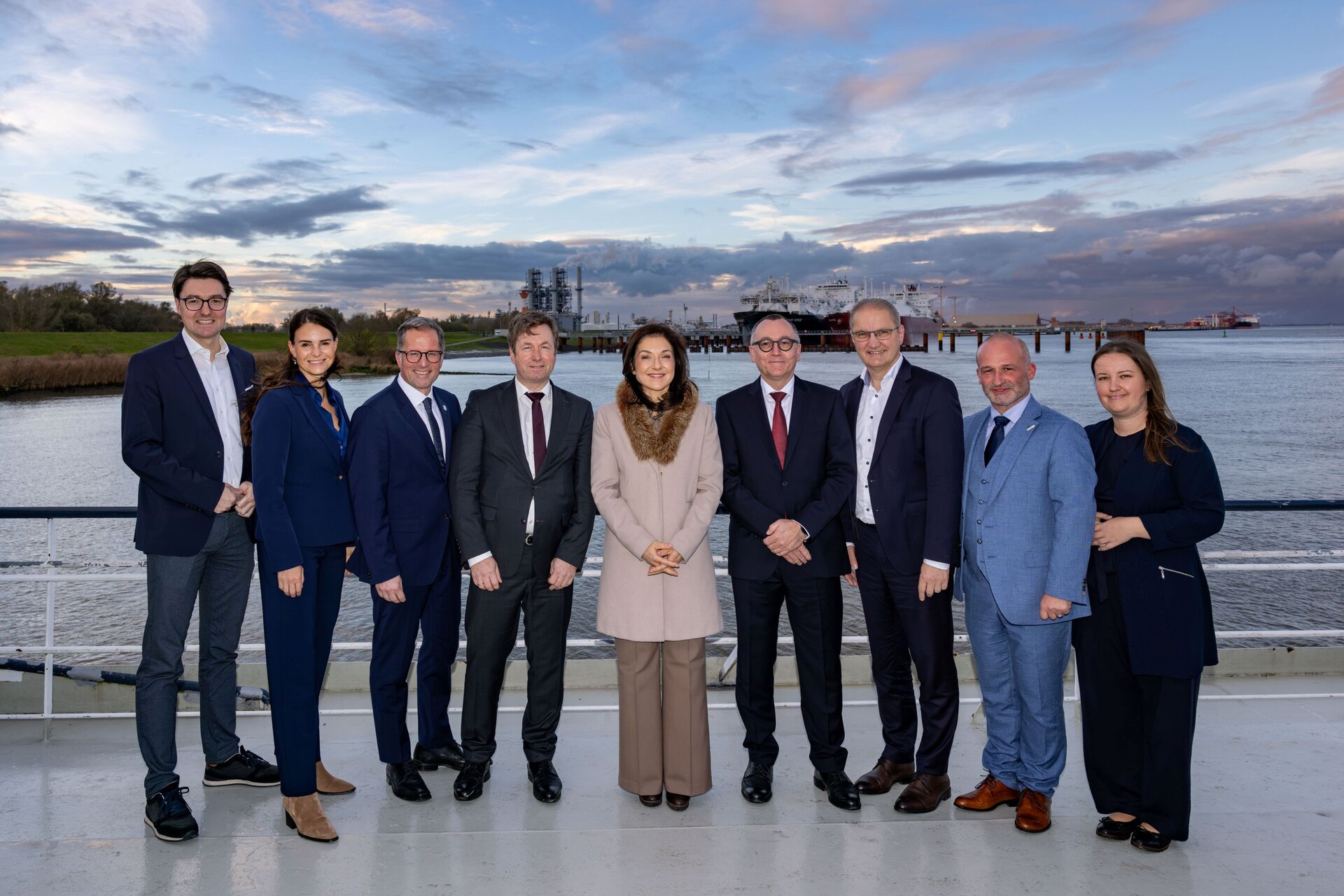
At a press event marking the commissioning in Stade on 16 November, Federal Minister for Economic Affairs Katherina Reiche, representatives of federal, state and local government, industry representatives and project management partners came together to recognize the commissioning of the terminal and its significance for Germany’s energy supply.
Katherina Reiche, Federal Minister for Economic Affairs and Energy
“With the LNG terminal in Stade, we are commissioning the fourth and final federally owned terminal. Four terminals in less than four years: this shows how quickly Germany can act when it matters. We have put our gas supply on a broader footing and are thus more independent of individual suppliers and transport routes. With the Energos Force, another import route is now being added that will strengthen our supply this winter already. In 2027, up to 3.2 billion cubic metres of natural gas are expected to be fed into the German gas grid via the Stade terminal. In theory, this corresponds to the annual heating energy demand of around 2.6 million four-person households.”
Olaf Lies, Minister-President of the State of Lower Saxony
“With the LNG terminal in Stade, we are strengthening Germany’s energy supply and making it more independent and more resilient. In a challenging time, Lower Saxony took on responsibility and made an important contribution to putting the energy supply on a broader footing. Security of supply is the prerequisite for economic strength. At the same time, we are looking ahead: we need an energy infrastructure that provides security today and paves the way to a climate-neutral energy supply tomorrow. Stade is an important location for this.”
Dr. Peter Röttgen, CEO and Spokesman of the Management Board of DET
“Realizing and commissioning four floating LNG terminals within four years was an extraordinary task and a joint effort by many parties. Having originally planned, permitted and built at several locations at once in an acute emergency, we now have, with the commissioning of the Stade site, four terminals for a secure and resilient energy supply for Germany.”
Special thanks go to the companies involved in realizing the Stade site: in particular Niedersachsen Ports, which completed the jetty on schedule, and Gasfin Development with Worley, which then completed the gas infrastructure on it. DET would also like to thank Gicon, Energos Infrastructure, Dow Deutschland, Gasunie Deutschland, Eiko, the Federal Ministry for Economic Affairs and Energy and the authorities involved for their respective support and cooperation on the project. The different expertise and contributions of the partners were key to realizing the Stade site.
With the construction phase complete, the focus now shifts to the further marketing of regasification capacity and to reliable operation at all times. The experience gained from delivering the four LNG terminals provides an important foundation for DET’s future work. It shows how complex infrastructure projects that are new to the German market can be delivered successfully, even under exceptional circumstances, by building targeted expertise.
The FSRU Energos Force is 294 meters long and was built in 2021. It has a deadweight tonnage (dwt) of 94,361 tonnes. In winter, with a closed-loop system using steam boilers, the vessel can regasify a maximum of 500 million standard cubic feet of gas per day (MMSCFD); in summer, with an open-loop system using water from the Elbe, ideally up to 750 million standard cubic feet per day.
In total, DET expects to feed in at least 98.8 TWh of energy in 2026. This corresponds to a natural gas volume of around 8.67 billion cubic meters. In theory, this amount of energy would cover the annual natural gas demand for heating around 7.06 million four-person households living in apartment buildings with 100 square meters of living space each.
