
Published on:
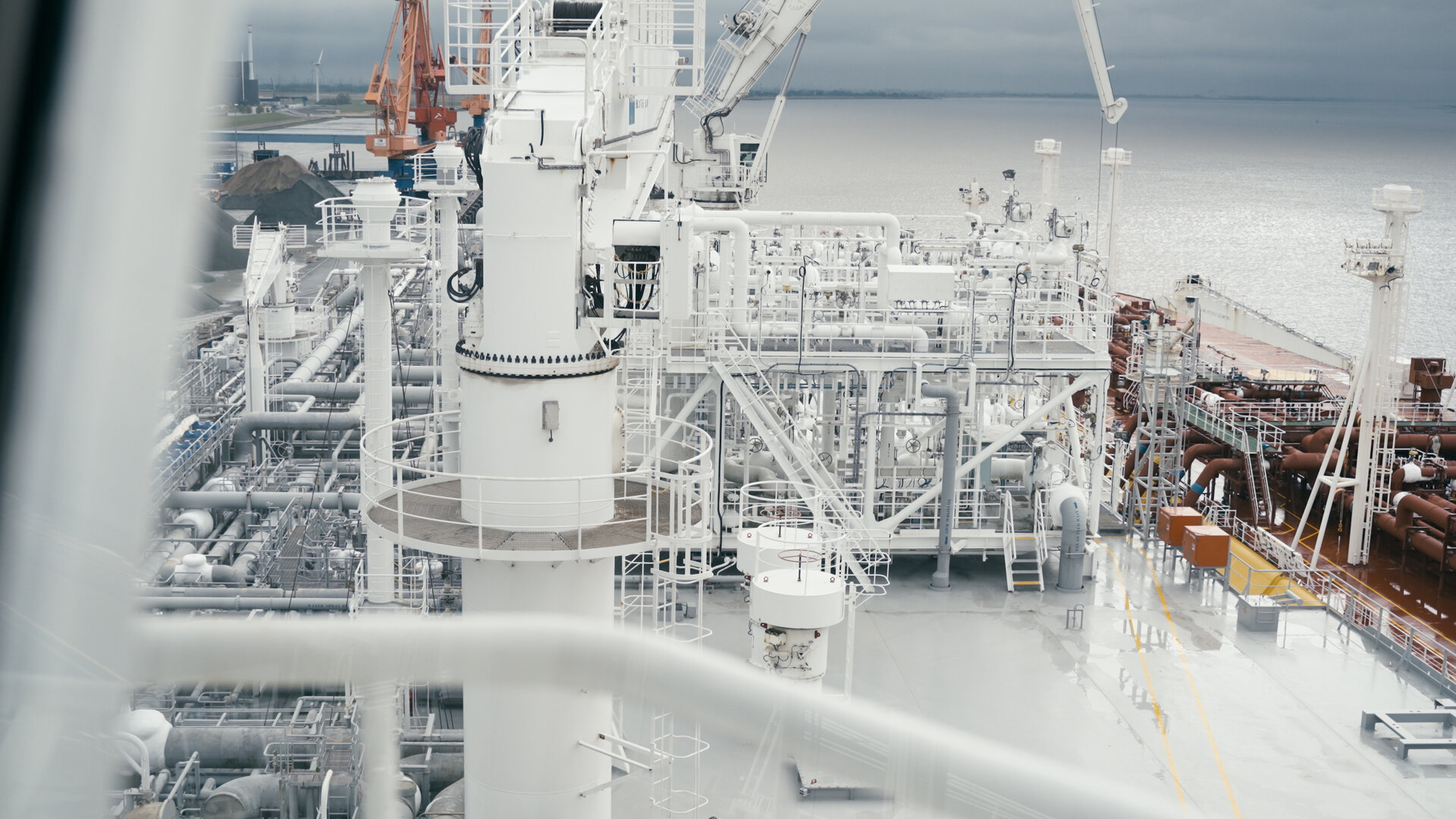
It is four o’clock in the morning. While most people are still asleep, a highly precise process is running around the clock aboard the floating industrial facility Höegh Gannet in the port of Brunsbüttel on the River Elbe: An LNG carrier has berthed, 150,000 cubic metres of liquefied natural gas are changing hands – and within a few days, this energy will flow through heating systems, stoves and industrial facilities across Germany.
What is LNG?
LNG stands for Liquefied Natural Gas. To make natural gas suitable for transport, it is cooled to –162°C. At this temperature, its volume shrinks to around one six-hundredth of its original volume. This makes LNG from production regions around the world efficient to transport by sea on specialised vessels known as LNG carriers (LNGCs).
From Carrier to Gas Grid – in Four Steps
- Berthing and Transfer
When an LNG carrier berths alongside DET’s FSRU, a carefully coordinated process begins. The captains and crews of both vessels coordinate the operation, check safety procedures and prepare the required regulatory documentation. The two vessels are connected by six specialised hoses: four transfer LNG from the carrier to the FSRU. Two additional hoses return so-called boil-off gas – natural gas that has formed in the FSRU’s tanks due to minimal warming. The carrier uses this gas as fuel for its return voyage, ensuring that no energy is lost. - Increasing the Pressure
The LNG is pumped from the tanks in the carrier’s hull and transferred to the regasification unit on deck. Compressor pumps, known as booster pumps, increase the pressure in the pipelines to more than 100 bar, preparing the LNG for the heating process. - Vaporisation at the Heart of the Process
The pressurised LNG flows into the vaporiser, the heart of the regasification process. Heat is transferred to the extremely cold LNG, gradually warming it up. At around –160°C, it begins to boil and changes back into a gaseous state. LNG becomes natural gas again – at a temperature of around 0°C. - Final Heating and Feed-In
The gas grid requires the gas to be at a defined temperature. In Brunsbüttel, this is around 7°C. In the final step, the natural gas therefore passes through a final heater before being fed into Germany’s natural gas grid via the onshore infrastructure, supplying households, industry and power plants.
A Special Energy Partnership: The Covestro Example
The Brunsbüttel site demonstrates how efficiently regasification can be carried out. Chemical company Covestro supplies waste heat from its production processes directly to the Höegh Gannet via water. This waste heat is used to warm the LNG and convert it back into natural gas. The resulting natural gas then supplies Covestro’s facilities once again.
What Does That Mean in Numbers?
Since beginning operations in Brunsbüttel, the Höegh Gannet has fed more than 79 terawatt-hours of energy in the form of natural gas into the grid (as of 27 August 2026) – enough to provide heating energy for a year to more than 5.6 million four-person households living in 100-square-metre apartments in multi-family buildings.