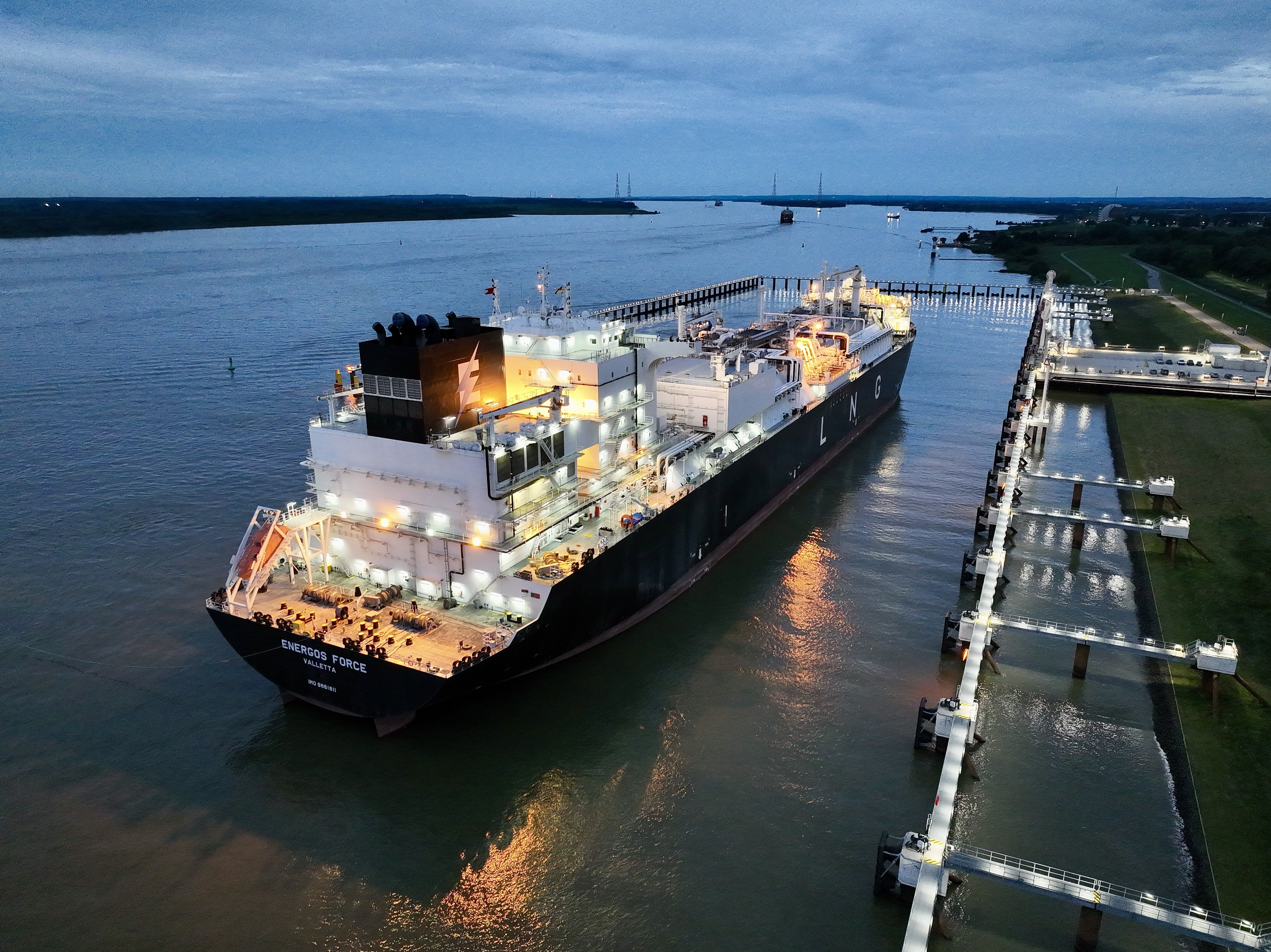
Energos Force has docked in Stade
Energos Force arrives in Stade
Published on: 16. September 2026
DET Begins Preparations to Commission the Floating LNG Terminal
The Floating Storage and Regasification Unit (FSRU) “Energos Force” docked yesterday at the new LNG terminal (AVG) in the Stade-Bützfleth industrial port. The arrival of the 294-meter-long vessel, chartered by Deutsche Energy Terminal GmbH (DET), marks the start of preparations to commission the Stade floating LNG terminal. Federal Minister for Economic Affairs and Energy Katherina Reiche: “With the arrival of the Energos Force in Stade, what security of supply means in practice is becoming visible. The FSRU, which is docking at the terminal today, can help ensure a reliable supply of energy to millions of households from November onwards. With an injection capacity of up to 3.2 billion cubic metres of natural gas per year by 2027, Stade will be an important component of Germany’s security of supply.”
Grant Hendrik Tonne, Lower Saxony’s Minister of Economic Affairs, Transportation, and Construction: “This sends a strong signal today in times of enormous challenges in energy policy. Lower Saxony, in particular, is fulfilling its special responsibility as an energy-producing state with its infrastructure and storage facilities. With three LNG terminals, the state is making a key contribution to the diversification of the gas supply. Incidentally, the terminal in Stade was approved at the time at ‘Lower Saxony speed,’ and NPorts created the necessary port infrastructure. That said, there is still much to be done to ensure a secure and affordable energy supply.”
CEO Dr. Peter Röttgen: “As promised, the return of the regasification vessel to the Stade jetty marks the start of preparations for the terminal’s commissioning. We expect the first fully loaded LNG tanker to come alongside in early November. From then on, Stade will begin feeding gas into the grid, thereby making the anticipated and important contribution to security of supply. The road to this point has not always been easy. Shortly after assuming responsibility for completion, we brought all necessary partners on board, who are working together with full commitment toward this common goal. I would like to take this opportunity to express my sincere thanks for ensuring that we can move forward at the necessary pace.”
For 2027, DET expects the Stade terminal to feed up to 3.2 billion cubic meters of natural gas into the grid. This volume would be sufficient to supply approximately 2.6 million four-person households with heating energy for a full year. Niedersachsen Ports (NPorts) constructed the jetty specifically for the FSRU and the onshore terminal, which is still under construction.
NPorts Managing Director Holger Banik said: “We are pleased to see the plans we developed together now taking shape. With the jetty, we have created the necessary infrastructure in the port for the terminal in Stade to begin operations. Ports are a crucial part of our state’s energy infrastructure today. Without the necessary capacity along the coast, the energy transition will not succeed. The fact that, in theory, around 2.6 million households can be supplied via Stade in the future demonstrates the scale and responsibility associated with this infrastructure.”
The FSRU Energos Force is 47 meters wide and was built in 2021. It has a deadweight tonnage (dwt) of 94,361 metric tons. In winter, the vessel can regasify up toof 500 million standard cubic feet of gas per day (MMSCFD) using steam boilers in a closed-loop system. In summer, it can ideally regasify up to 750 million standard cubic feet per day using Elbe River water in an open-loop system. The expected feed-in capacity for 2027 of up to 3.2 billion cubic meters of gas represents the so-called DTRS value (Declared Total Reference Send-Out)—the maximum technically feasible system output under ideal conditions, without restrictions caused by extreme weather conditions, unplanned grid constraints, cancellations by LNG suppliers, or technical malfunctions. In addition, lower feed-in volumes resulting from the actual sizes of the delivered cargoes must be taken into account.
Note: Photo material for your reporting will be available on the morning of September 17 in the DET media library at energy-terminal.de/aktuelles/media